


Business Drive for Sustainability
For more than 40 years, TBSP Public Company Limited was established in 1978 with the objective of producing counterfeit-free documents, checks and important financial instruments. Including various forms of the bank and at present. The company has adjusted its business operations and focused on operating a complete card production business from graphic design, prototype making, card production, card data entry, including delivery to customers or customers directly to the cardholder through various channels. We provide various types of plastic cards, including smart cards, chip cards, payment cards, membership cards and cash cards. It also provides design services with various techniques on the card, the company currently has 1 production area which is Pu Chao Saming Phrai Factory.
In addition, the Company has changed the vision, mission and values of the organization to be consistent and in the same direction as the affiliated companies. Including adjusting the strategy and improving the Company’s management system to develop products and services as well as expanding the new customer base by looking for partners to cooperate with research and development institutes (Research & Development) both domestically and internationally in the development of raw materials, printing techniques, label formats and packaging to be more different and more modern. It also focuses on building culture and increasing the potential of personnel in the organization by bringing innovation and technology into use In line with the Company’s new vision of being a global leader in creating innovative products and services for quality and effective anti-counterfeiting with modern, integrated and sustainable technology. (To be the regional trusted leader in information security solutions with technology integration.)

Social Responsibility Policy
- Promote activities in safety, occupational health and working environment to reduce the risk of accidents at work for both employees and business partners.
- Promote activities to reduce impacts on environmental resources to conduct business in a friendly manner with the community.
- Promote economic activities within the community by creating jobs and promote careers for employees and communities.
- Promote business operations with good corporate governance principles. Which consists of the company’s ideology Code of Conduct and Corporate Governance Including anti-corruption in all forms with a focus on communication across the organization business partner and stakeholders in all sectors.
Strategic Plans and Long-Term Goals for 5 Years (2022 – 2026)
The company has planned strategies and goals of the organization. The objective is to prepare for a significant change in becoming a national leader in the business of selling tickets, providing data entry services. with various solutions full cycle for Financial institutions and customer segments that take advantage of membership, data collection, authentication, card-based payment applications with a high-security card system of international standards with a wide range of solutions to both Corporate customers, SMEs and individuals by introducing modern technology to be a part of business operations Aiming for a new business model Also looking for ways to expand the new customer base and cooperation partners. for business growth Increasing efficiency in resource management while creating core values of the organization, creating and developing people with innovation and technology skills. It also has operational excellence and strives to be an organization with honesty and transparency professionalism as well as looking after and caring for the surrounding community and society as well as all stakeholders to create sustainable shared values.
Compliance with The International Principles of The UN Global Compact
The Company has been a member of the Global Compact Network Thailand (GCNT) since 2002, which will contribute to the implementation of the Sustainable Development Goals in Thailand. Apply ten international principles to business operations and social responsibility policies. which covers human rights issues, labor practices environment and anti-corruption as follows:
| Point | Ten Principles | Company’s Operating Guidelines |
| Human Rights | 1. Support and respect the protection of internationally proclaimed human rights within the jurisdiction that permits. 2. Regularly monitor and ensure that their businesses are not involved in human rights violations. |
1. Specify respect for human rights in the company’s code of conduct. 2. Establish a communication channel and whistleblower system to receive complaints and whistleblowers for improper actions or violations of the law by setting up measures to protect complainants and mitigate damages to reporters. |
| Labor Practices | 1. Seriously promote and support labor freedom of association and the right to collective bargaining. 2. Eliminate underage labor and use all forms of coercion. 3. Seriously abolish child labor. 4. Eliminate discrimination in employment and occupation. |
1. Determine the treatment of employees in the Company’s business ethics without discrimination and labor discrimination. 2. There is a policy against child labor and forced labor. 3. Support the employment of people with disabilities. 4. Listen to employees’ opinions by providing communication channels, suggestion boxes and complaint systems and report clues. |
| Environmental | 1. Support a precautionary approach in operations that may affect the environment. 2. Volunteer to organize activities that promote the elevation of social responsibility. 3. Promote the development and dissemination of environmentally friendly technologies. |
1. Determine business operations that take into account the impact on the environment by having a policy to conserve and reduce the use of resources, reduce waste, including creating awareness of environmental protection in the workplace and surrounding communities. 2. Set up a wastewater treatment system to control the impact from the production process and prepare a report to relevant government agencies. |
| Anti-Corruption | 1. Work against corruption in all forms including giving, offering and bribery. | 1. Declaration of the intention of joining the Private Sector Collective Action Coalition Against Corruption of the Company and its subsidiaries. 2. Define and announce the anti-corruption policy to be practiced throughout the organization. 3. Provide communication channels and systems for receiving complaints and complaints. Notify clues about wrongdoing or violation of the law. by prescribing measures to protect the complainant and alleviate the damage to the complainant. 4. The Company has prepared a Supplier Code of Conduct for business partners and business partners of the Company to have a correct understanding and apply it as a standard for conducting business together. |
Stakeholder Analysis in The Business Value Chain
Identification of stakeholders, The company will consider from the scope of operations of the company by analyzing the value chain and identify internal and external stakeholders who are affected or affect the Company’s operations and consider the importance of various groups of stakeholders, which can be identified as follows :








In 2021, the company established a relationship with representative groups of stakeholders in accordance with AA1000 Stakeholder Engagement Standard (AA1000SES) and GRI Standards. The opinions from the stakeholders will be taken as one of the factors in the process of assessing important sustainability issues of the Company. In the future, the Company will use such opinions and suggestions to develop a relationship building plan with stakeholders to improve operations and progress reports to the Board of Directors.
Sustainability Assessment Results
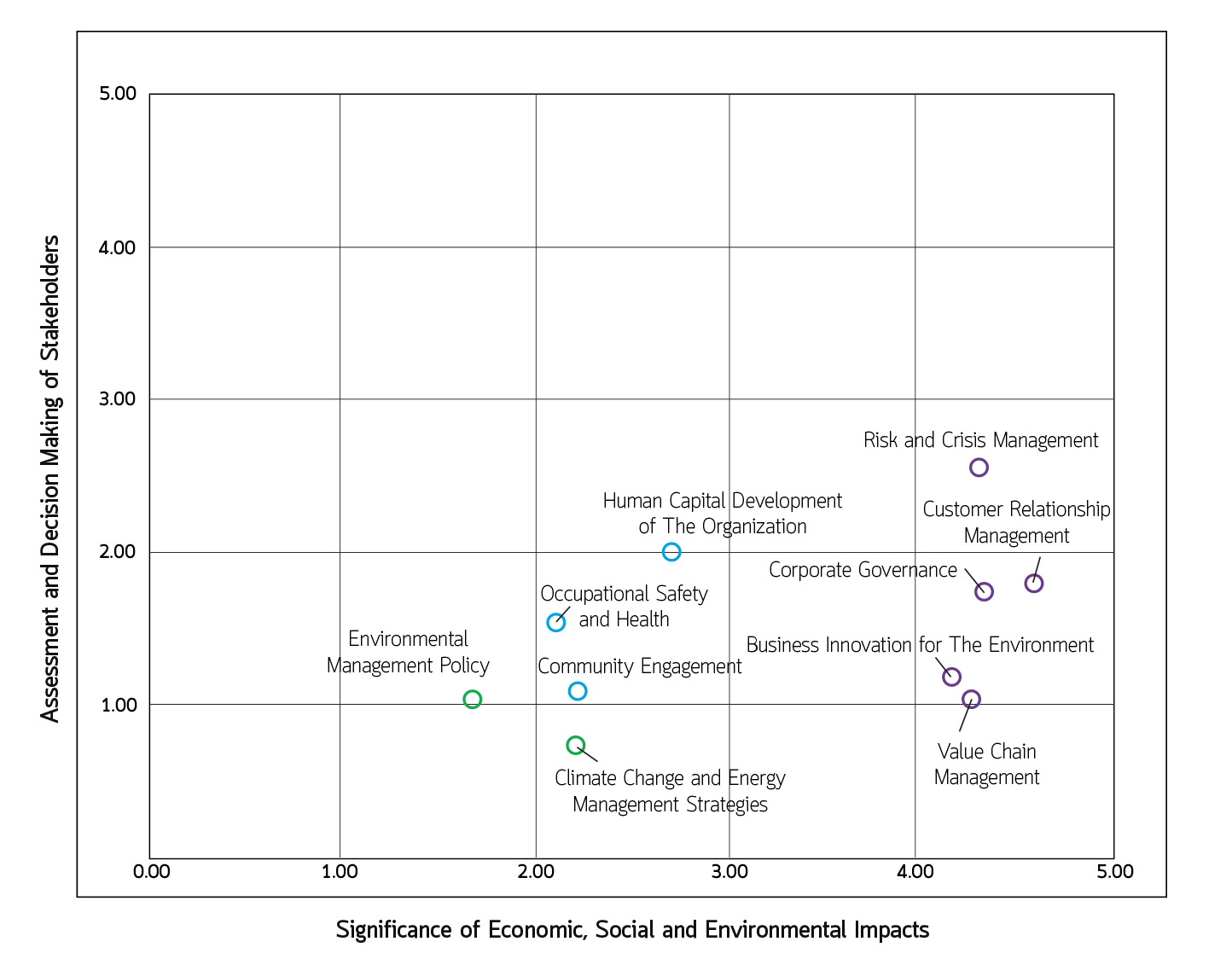
The company has grouped important issues in sustainability into 3 groups in order to determine management guidelines as follows:

• Supply Chain Management
• Customer Relationship Management
• Risk and Crisis Management
• Business Innovation for The Environment and Society

• Environmental Policy and Management System

• Human Capital Management
• Community Participation
Sustainability Management Goals
The company is committed to being a leader in the production and distribution of all kinds of anti-counterfeiting publications with a mission to raise the level of trust and sustainability for stakeholders. As an important participant in business operations. In the future, the company plans to set strategies and directions for corporate sustainability. Sustainability Management to show social and environmental responsibility which focuses on creating sustainable growth as follows:
| Economic and Governance Dimension | ||
| Strategic Direction | Operational Goals | Supporting the Sustainable Development Goals |
| Strengthen governance mechanisms and promote transparency across the organization. |
|
 |
| Enhance value chain management by considering environmental, social and economic impacts. |
|
   |
| Satisfy customers to improve products and services. |
|
|
| Strengthen risk management and internal control systems and prioritize risks. |
|

|
| Introducing advanced technology to improve the design business |
|
|
| Environmental Dimension | ||
| Strategic Direction | Operational Goals | Supporting the Sustainable Development Goals |
| Climate change considerations to reduce environmental impact and efficient energy management |
|
 |
| Policy formulation and management system to reduce environmental risks |
|
 |
| Social Dimension | ||
| Strategic Direction |
Operational Goals |
Supporting the Sustainable Development Goals |
| Improving the quality of life and safety in the workplace for employees and those involved. |
|
|
| Treating all employees equally |
|
|
|
Maintaining good relations with the community and building credibility for the company’s image.
|
|
|
Overview of The Operation and Management of Key Sustainability Issues
The Company realizes and sees the importance of promoting sustainable development. Therefore, focusing on business operations. It is in line with the Ten Principles of the UN Global Compact and the Sustainable Development Goals (SDGs) of the United Nations (UN). Sustainability of the Company for the maximum benefit to all stakeholders.
| Dimension | Results of Operations |
Economy and Governance
|
|
Environment
|
|
Society |
|
